
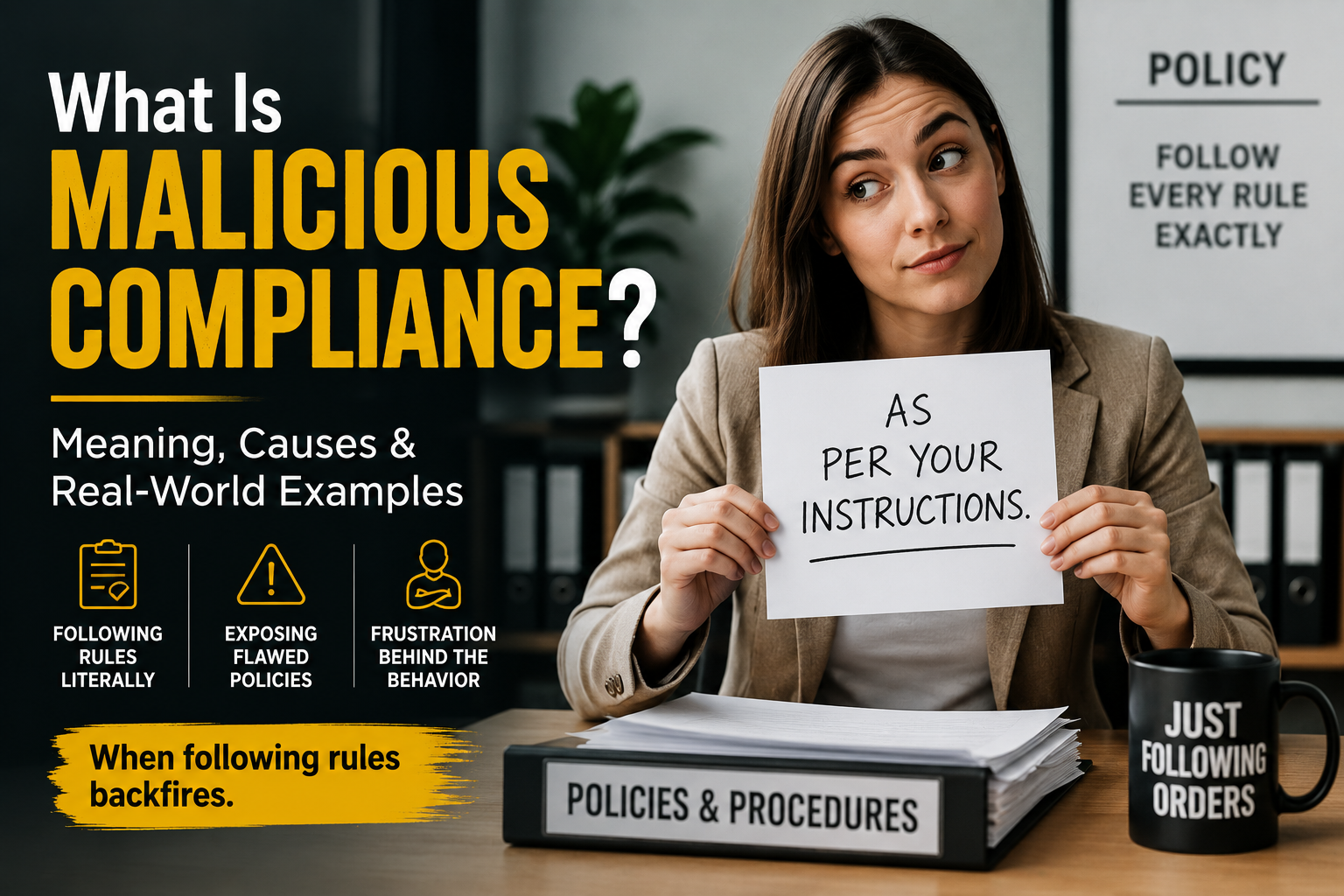
What Is Malicious Compliance? Meaning, Causes, and Workplace Examples
You may have seen someone follow a workplace rule so literally that the result becomes inefficient, inconvenient, or embarrassing for the person who created it. That behavior is called malicious compliance. It can happen in offices, retail stores, warehouses, restaurants, government departments, and remote teams across the USA.
The employee technically follows the instruction, but does so in a way that exposes how unreasonable, vague, or poorly designed the rule is.
What Does Malicious Compliance Mean?
Malicious compliance is the deliberate act of following an order exactly while knowing that strict obedience may create a negative or absurd result. The employee does not openly refuse the instruction. Instead, they remove common sense, personal judgment, and flexibility from the task.
Imagine a manager telling an employee, “Do not make any decisions without my approval.” The manager then becomes unavailable for several hours. Rather than handling simple issues independently, the worker pauses every task and waits. Customers become frustrated, deadlines are missed, and productivity falls.
The instruction was followed, but its weakness became obvious.
This behavior is different from an honest misunderstanding. The person usually recognizes the likely consequence and allows it to happen intentionally.
Malicious Compliance Examples in American Workplaces
Many malicious compliance examples begin with a rule that ignores how the workplace actually operates.
A supervisor may require every employee to leave at exactly 5:00 p.m., even during urgent projects. An employee who previously stayed a few extra minutes begins shutting down at precisely 5:00, leaving unfinished work for the following morning.
Another situation may involve a company that requires written approval for every refund. A customer has an obvious billing error, but the approving manager is away. The employee refuses to correct it and repeats the company policy word for word, even though the delay may cost the business a loyal customer.
These malicious compliance examples are especially common when employees believe that raising concerns will not lead to meaningful change.
What Causes Malicious Compliance?
People rarely choose malicious compliance without frustration building first. It often develops after repeated micromanagement, unclear instructions, inconsistent treatment, or rules that punish initiative.
An employee may have explained several times that a process is inefficient, only to be ignored. Following the rule exactly can then feel like a way to prove the point without directly challenging management.
Burnout may also contribute. When workers feel undervalued, they sometimes stop protecting the organization from the consequences of poor decisions. They do exactly what they were told—nothing more.
Fear is another major factor. Employees who are criticized whenever they use independent judgment eventually learn to avoid making decisions altogether.
Malicious Compliance Examples in Customer Service
Customer-facing businesses provide some of the clearest malicious compliance examples because rigid rules quickly affect real people.
A restaurant worker may be told never to change a menu item. When a customer asks to remove one simple ingredient, the employee refuses, even though the kitchen could easily accommodate the request.
A call center representative may be evaluated only by call length. To meet the company target, the representative ends conversations quickly instead of fully resolving customer problems. The average call time improves, but repeat calls and complaints increase.
A delivery company may require drivers to follow an exact route. A driver follows it even when construction makes the route much slower, resulting in late deliveries.
Is Malicious Compliance the Same as Quiet Quitting?
Malicious compliance and quiet quitting are related, but they are not the same.
Quiet quitting usually means limiting work to the responsibilities included in the employee’s job description. The employee may stop working unpaid overtime or handling duties that belong to someone else. In many cases, that is simply boundary-setting.
Malicious compliance is more intentional. The employee applies a rule in a way that highlights its weakness or allows a predictable negative result.
One behavior reduces extra effort. The other uses literal obedience as a form of protest.
Malicious Compliance Examples Caused by Micromanagement
Some of the most damaging malicious compliance examples happen under micromanagers.
A manager may require approval for every email, purchase, schedule change, or customer response. Employees then stop acting independently and wait for permission at every stage.
The manager may later complain that the team lacks initiative, but the system has trained everyone not to take initiative. Work becomes slower, small issues turn into bottlenecks, and the entire team becomes dependent on one person.
Another example is a supervisor who insists that reports follow an outdated format. Employees continue using the format even when it hides useful information because earlier suggestions for improvement were rejected.
How Malicious Compliance Hurts a Business
Malicious compliance can damage productivity, employee morale, customer relationships, and trust.
One incident may appear minor, but repeated incidents create a workplace where employees focus on protecting themselves instead of helping the organization succeed.
It can also increase staff turnover. Skilled employees generally want enough freedom to solve problems. If every decision is controlled, they may leave for companies that value judgment and communication.
Managers lose time as well. They must approve minor decisions, repair preventable mistakes, and manage customer complaints that frontline employees could have resolved.
Malicious Compliance Examples and Healthy Boundaries
Not every act of strict rule-following is hostile. Some malicious compliance examples may actually reveal that employees have been carrying too much unpaid or unrecognized responsibility.
An employee who stops staying late without compensation may simply be enforcing a reasonable boundary. A worker who refuses an unsafe instruction may be protecting both themselves and the company.
Managers should examine the context before labeling someone difficult.
The main question is whether the employee is protecting a legitimate boundary or deliberately using a flawed instruction to produce a harmful result.
How Managers Can Prevent It
The best solution is not stricter discipline. It is better leadership.
Managers should explain the purpose behind important policies, invite practical feedback, and allow reasonable exceptions. Employees also need to understand where they have decision-making authority and when an issue should be escalated.
Leaders can reduce problems by:
- Asking employees how policies work in real situations
- Rewarding responsible judgment
- Reviewing rules that repeatedly cause delays
- Correcting unclear instructions without blaming employees
- Making it safe to raise concerns respectfully
When employees feel heard, they are less likely to use malicious compliance as their only way to expose a broken process.
Malicious Compliance Examples Employees Should Avoid
Some malicious compliance examples can create serious consequences for workers. Deliberately allowing a customer problem to become worse, ignoring a safety risk, or causing a project to fail may result in disciplinary action.
A better approach is to document the concern and explain the likely outcome clearly.
For example:
“Following this process exactly may delay the customer response by two days.”
This gives the manager a chance to reconsider the instruction.
If the issue involves wages, discrimination, safety, or legal risk, the employee should use the company’s formal reporting process and keep written records. Professional communication usually offers better protection than silent retaliation.
Final Thoughts
Malicious compliance is often a symptom rather than the original problem. It may indicate that employees do not trust management, do not feel heard, or believe that initiative will be punished.
Clear expectations, reasonable autonomy, and respectful communication reduce the temptation to follow a bad rule in the most damaging possible way.
Businesses that listen to employees early are less likely to face frustrated customers, disengaged teams, and preventable workplace conflicts.
FAQs
Can an employee be fired for malicious compliance?
Yes. If the behavior causes harm, violates company policy, or demonstrates deliberate misconduct, the employer may take disciplinary action.
Is malicious compliance always intentional?
Usually, yes. The person generally understands that following the instruction literally may produce a poor result and proceeds anyway.